
6 Surprising Facts About St Peter’s Basilica
May 24, 2026
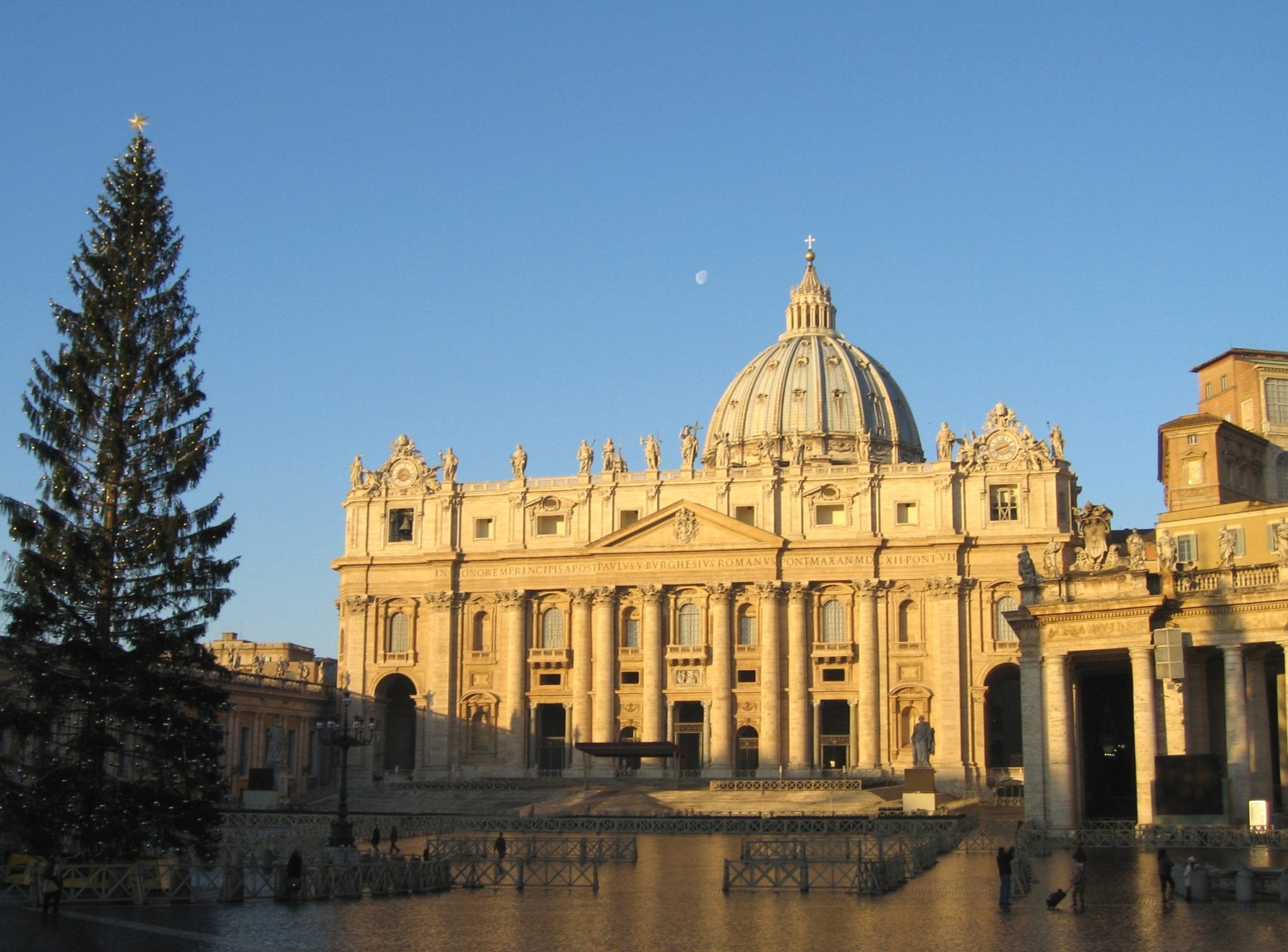
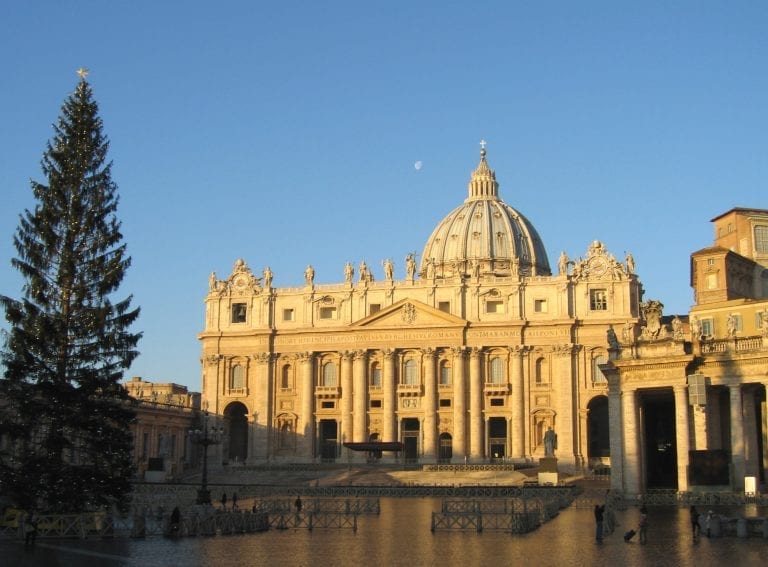
St. Peter’s Basilica, the ultimate symbol of the Vatican, is the spiritual heart of the Catholic world and one of the most recognisable buildings on the planet. It attracts millions of visitors every year. But beyond the jaw-dropping architecture and famous artworks lies a history that is just as extraordinary as the building itself. A history involving Roman emperors, Renaissance geniuses, buried saints and more!
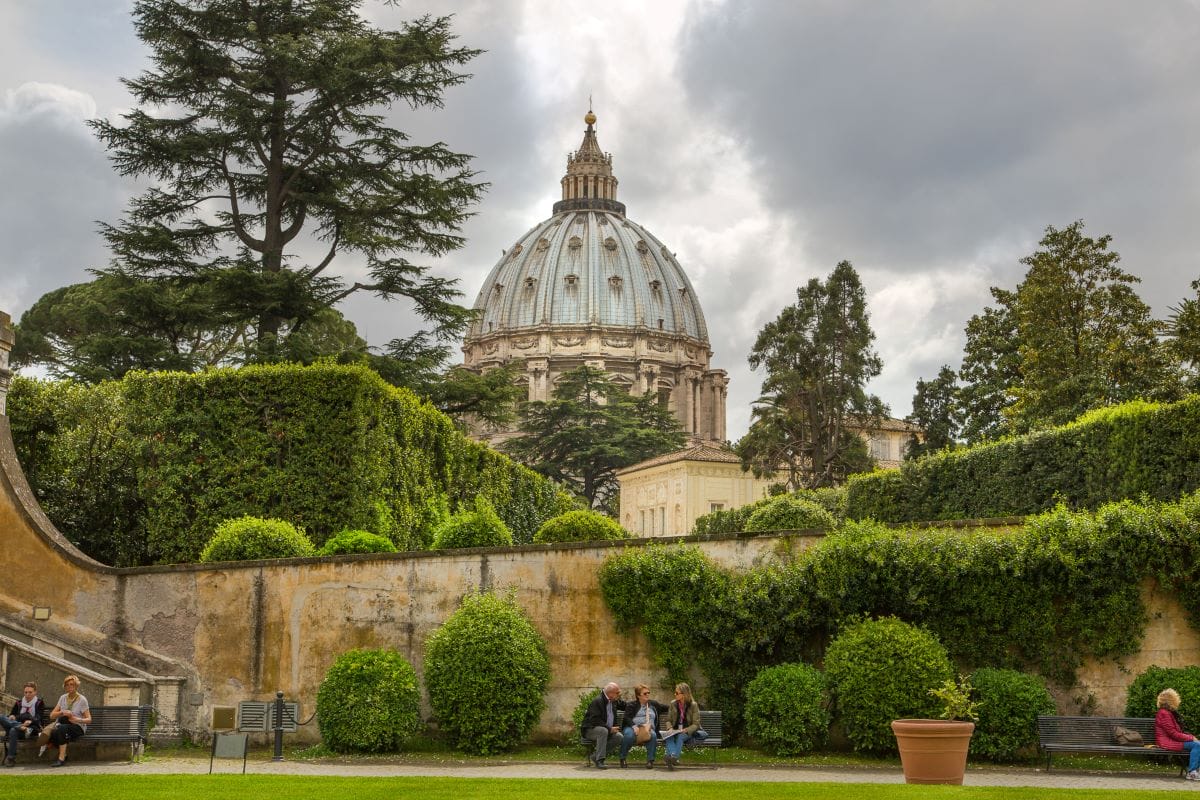
You can catch a glimpse of St Peter´s Basilica on the skyline from almost anywhere in Rome
Essential Facts About St. Peter’s Basilica
Before we get into the surprising stuff, here are a few key facts about one of the most iconic churches on earth.
When was St. Peter’s Basilica built?
The current St. Peter’s Basilica took an incredible 120 years to build, from 1506 to 1626, and involved some of the greatest artistic minds in history, including Donato Bramante, Michelangelo, Carlo Maderno, and Gian Lorenzo Bernini.
But the site itself is much older. For nearly 1,700 years, Christians have worshipped here, ever since Emperor Constantine the Great built the original church in the 4th century over what was believed to be the tomb of St. Peter.
This means is have essentially been one of Christianity’s most important sacred sites for nearly 1,700 years.
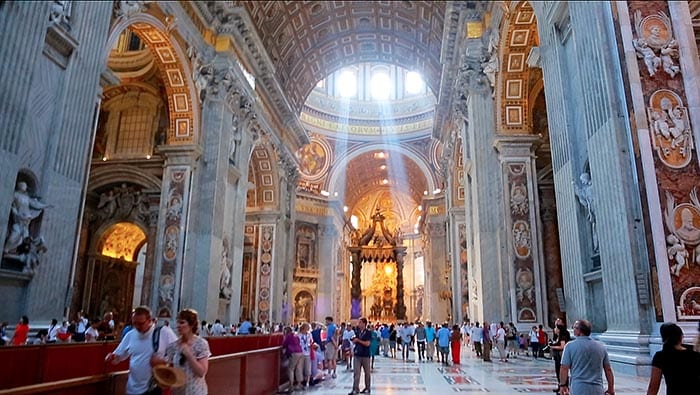
The rays of sunlight highlight the famous baldacchino canopy, created by Bernini, showing the sheer scale and size.
How tall is St. Peter’s Basilica?
The basilica’s famous dome rises to 452 feet (138 metres), making it one of the tallest church domes in the world and one of the defining features of the Rome skyline.
But that’s just the beginning. St. Peter’s stretches 730 feet (220 metres) from end to end, more than two football fields long, and covers over 163,000 square feet (15,160 square metres), enough space to hold around 60,000 people at once.
Inside, the sense of scale continues. Bernini’s spectacular Baldacchino, the bronze canopy above the papal altar, stands at 96 feet (29 metres), roughly the height of a 10-storey building. It only looks modest because the dome above it is so enormous.
Even the details are giant: the letters circling the inside of the dome look elegant and delicate from the floor, but each one is actually about 7 feet (2 metres) tall—roughly the height of an adult man.
That’s one of St. Peter’s greatest tricks: it constantly fools your sense of scale. Everything feels beautifully balanced—until you realise just how colossal it really is.
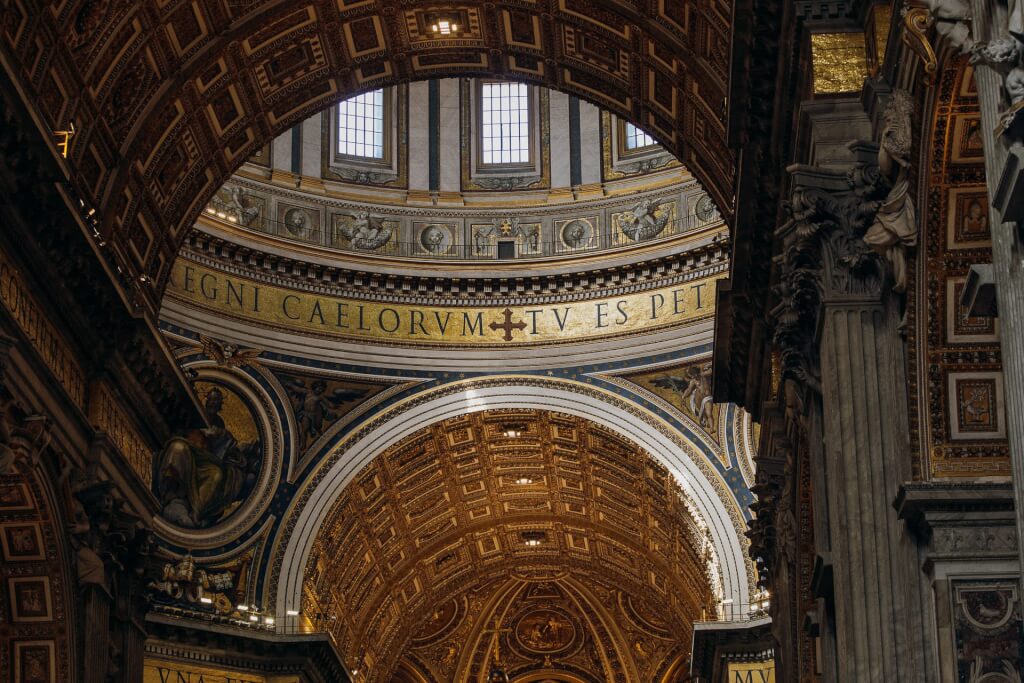
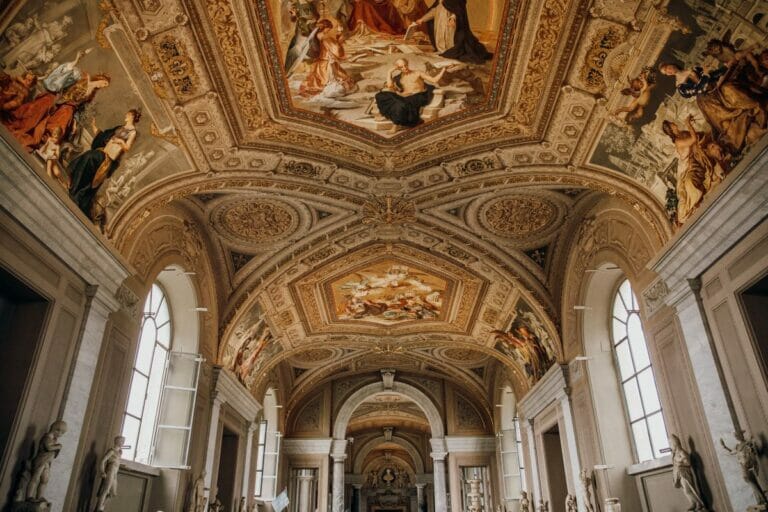
The intricate ceiling and dome designed by Michelangelo
6 Surprising Facts About St Peter’s Basilica
Here are 6 surprising facts about St Peter’s Basilica that you might not know about!
1. This isn’t the original St. Peter’s Basilica
The imposing church you see today isn’t the original basilica of St. Peter. It’s actually… number two! The reason? The original church was built in the 4th century by Emperor Constantine, the Roman empire’s first Christian emperor, on the spot where St. Peter was thought to be buried.
By the early Renaissance, though, the ancient church was in serious disrepair and was badly deteriorating. Rather than patch it up, Pope Julius II made the bold decision to tear it down and start over. The result? Sadly, thousands of pieces of priceless ancient art, from glittering early Christian mosaics to marble tombs, frescoes, and centuries-old sculptures, were lost forever during the demolition of Old St. Peter’s, a decision that sparked controversy even at the time.
Some Romans were horrified that a church standing for over a millennium could simply be torn down.But Pope Julius II was thinking bigger, much bigger.
St. Peter’s Basilica isn’t just beautiful… it’s fascinating!
2. St. Peter’s Basilica isn’t a cathedral or the official seat of the Pope
Even though St. Peter’s is the pope’s most famous church and the site of major papal ceremonies, it is not the official cathedral of Rome, or even the highest-ranking church in the Catholic Church. This surprises almost everyone.
That honour belongs to Archbasilica of Saint John Lateran, often overlooked by visitors but considered the “mother church” of Catholicism, and one of the most incredible churches in Italy.
But because of the size of St. Peter’s, and its location next to the residence of the Pope, most of the Church’s most crucial ceremonies are held here instead, which is exactly why so many travelers choose to visit St Peter’s Basilica when they come to Rome.
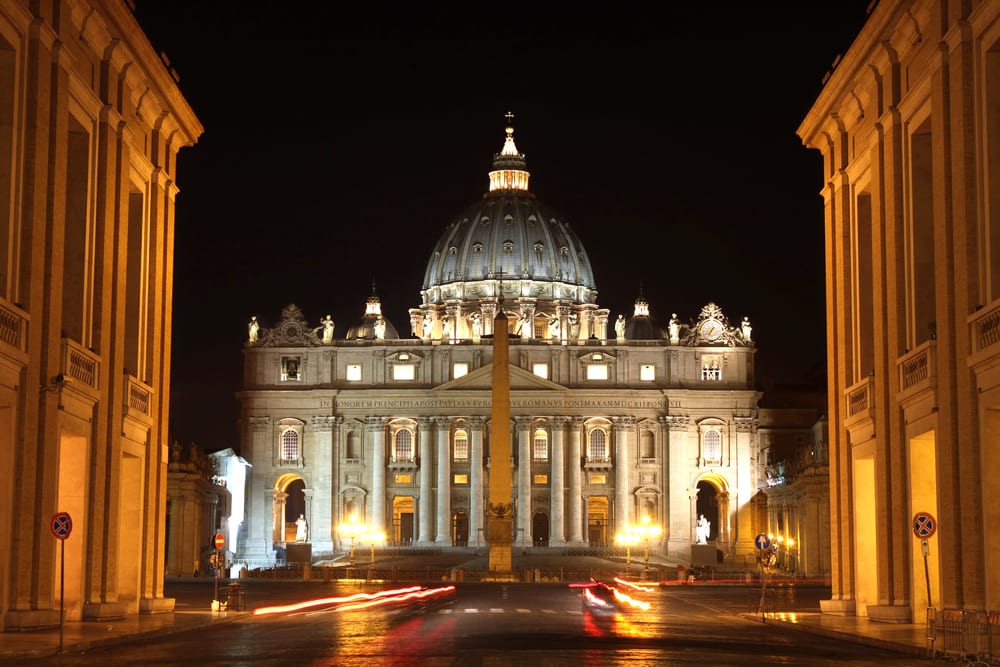
St Peter´s Basilica, beautifully illuminated at night
3. Bernini’s baldacchino is the largest bronze structure in the world
The four-poster, solid-bronze canopy over the main altar, known as the Baldacchino of St. Peter’s, appears almost dwarfed by the dome towering above it. But don’t be fooled. It stands 96 feet (29 metres) tall, about the height of a 10-storey building, making it the largest bronze structure of its kind in the world.
It took nearly nine years to complete, from 1625 to 1634, and used around 100,000 pounds (45,000 kilograms) of bronze, roughly the weight of seven London double-decker buses.
Its four dramatic spiral columns each rise around 66 feet (20 metres) and were designed to look like giant twisting ribbons reaching upward toward the dome.
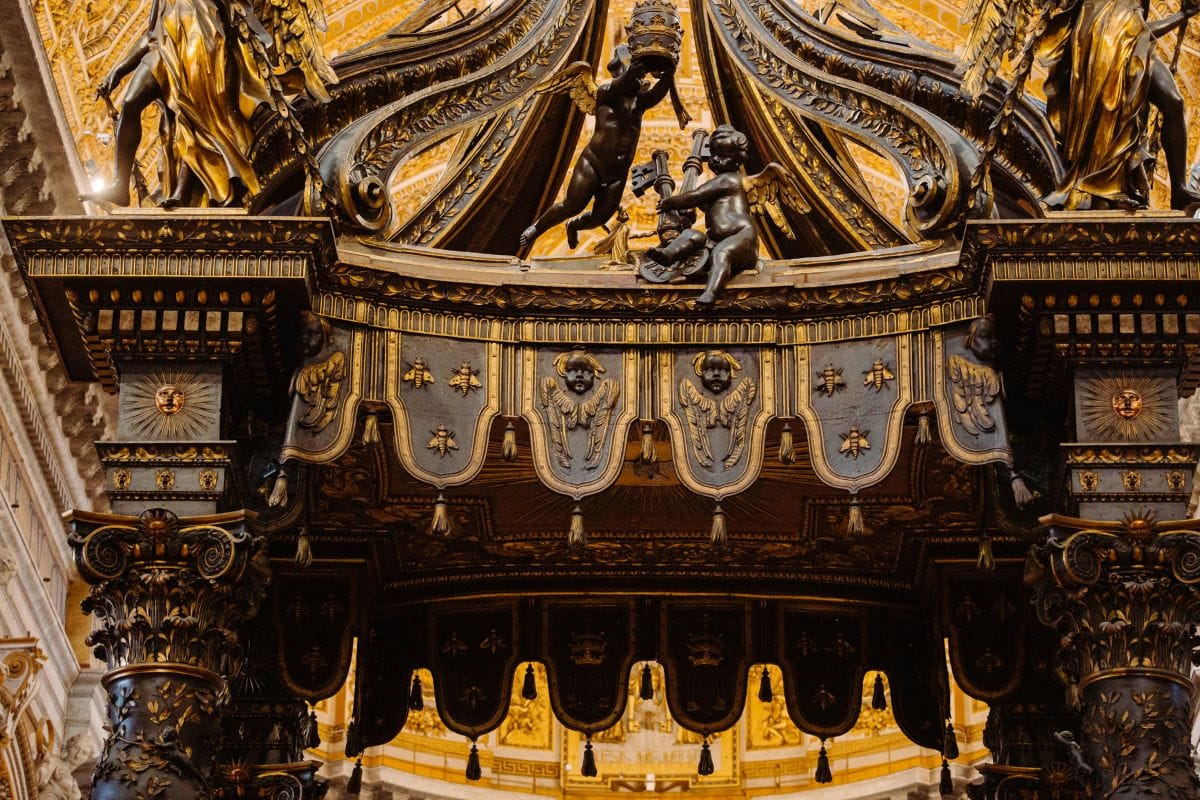
Bernini’s Baldacchino canopy in St. Peter’s Basilica is made put of bronze with gold accents and various small statues of angels.
4. None of the paintings inside the basilica are actually paintings
Huh? No, really. Although, at first glance, the basilica’s interior appears to be elaborately decorated with paintings – from frescoes in the dome to the huge paintings hanging on the walls – it’s not.
Every single one of those “paintings” is actually a mosaic, done with such painstaking detail, and such tiny tesserae (the little pieces of glass making the mosaic up), that they only appear to be paintings.
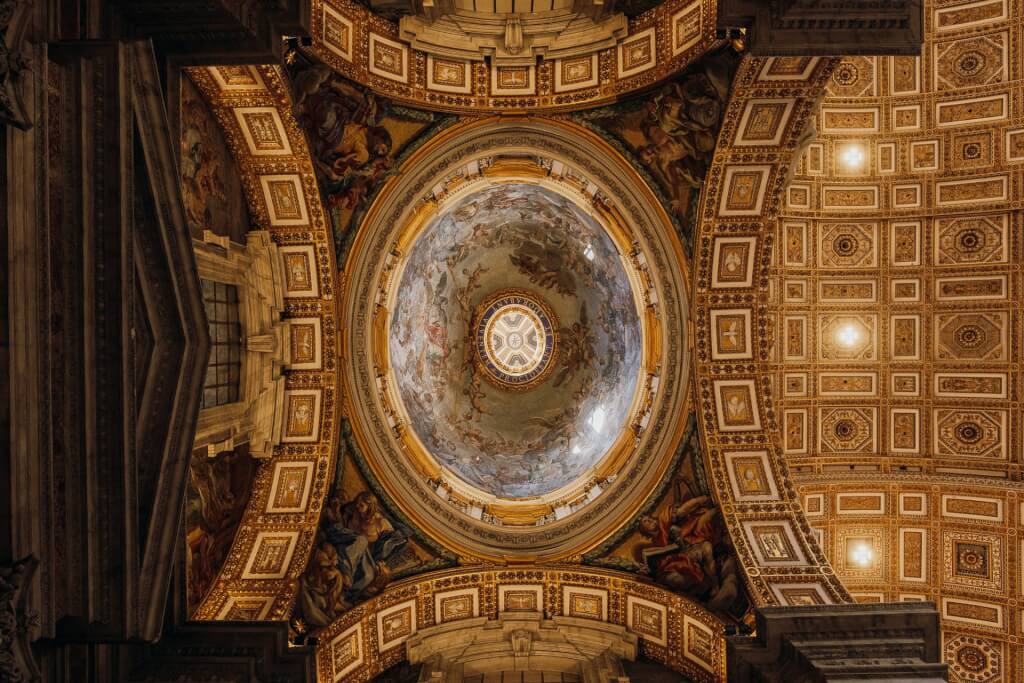
The interior of St. Peter’s Basilica Dome, looks like paintings, but it is actually decorated in mosaics
5. Michelangelo’s Pietà is shielded by bullet-proof glass
St. Peter’s Basilica is the home to one of Michelangelo’s most famous masterpieces, the Pietà (which, by the way, he carved when he was only 24 years old).
But not everyone’s been a fan of the stunning sculpture. In 1972, a mentally-disturbed man named Laszlo Toth attacked the sculpture with a hammer; he cracked off Mary’s nose and broke off her arm at the elbow.
The sculpture was painstakingly restored and returned to St. Peter’s, but now, it’s protected by bullet-proof glass—even as other priceless sculptures in St. Peter’s remain out in the open.
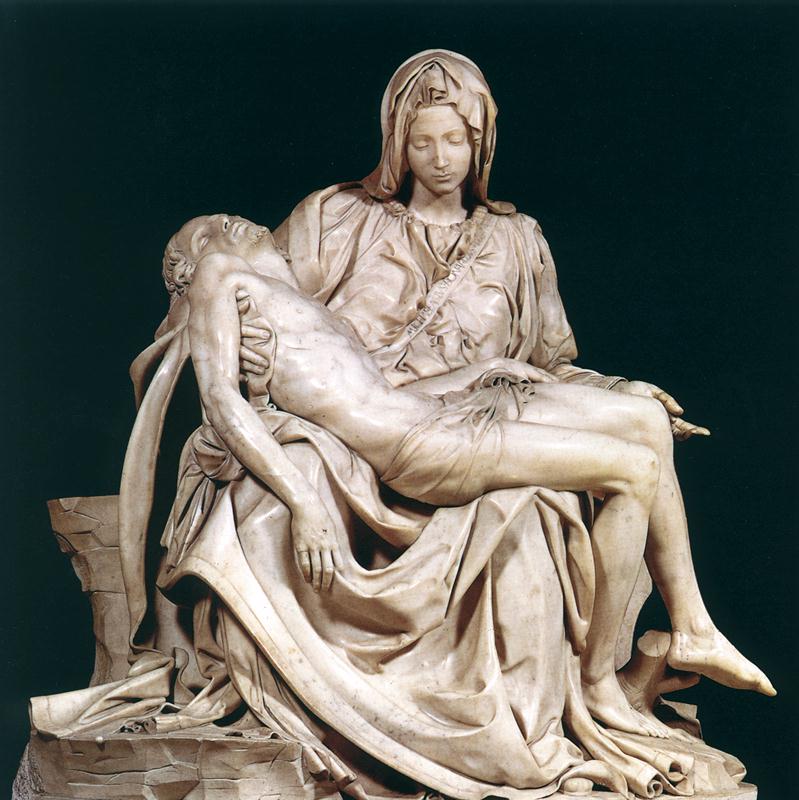
The Pieta, in St. Peter’s Basilica
6. St. Peter might be buried beneath the basilica
The reason why Emperor Constantine built the first St. Peter’s Basilica where he did, and why the “new” St. Peter’s was arranged with its altar directly over the same spot, was because this is where St. Peter’s bones were thought to lie.
Of course, this was hard to prove. But in the 1940s, excavations were done on the rumored spot. And, in 1953, a set of bones were found. Testing revealed they belonged to a man in his 60s, the same age that Peter would have been. Earth was encrusted on the bones, and Peter originally was buried directly in the dirt. And the bones had remnants of purple thread, a color of cloth that only would have been used in ancient times to wrap the body of someone who was seen as royal (or holy). For these reasons, Italian archaeologist Margherita Guarducci, among others, argued that the bones belonged to St. Peter.
Of course, others disagree – and it’s certainly not solid proof that the bones are St. Peter’s. But the findings don’t prove that the bones don’t belong to St. Peter, either.
Insider tip: Today, visitors can actually tour the dome and crypts of St Peter’s Basilica to explore both the basilica’s soaring heights and its fascinating underground necropolis.
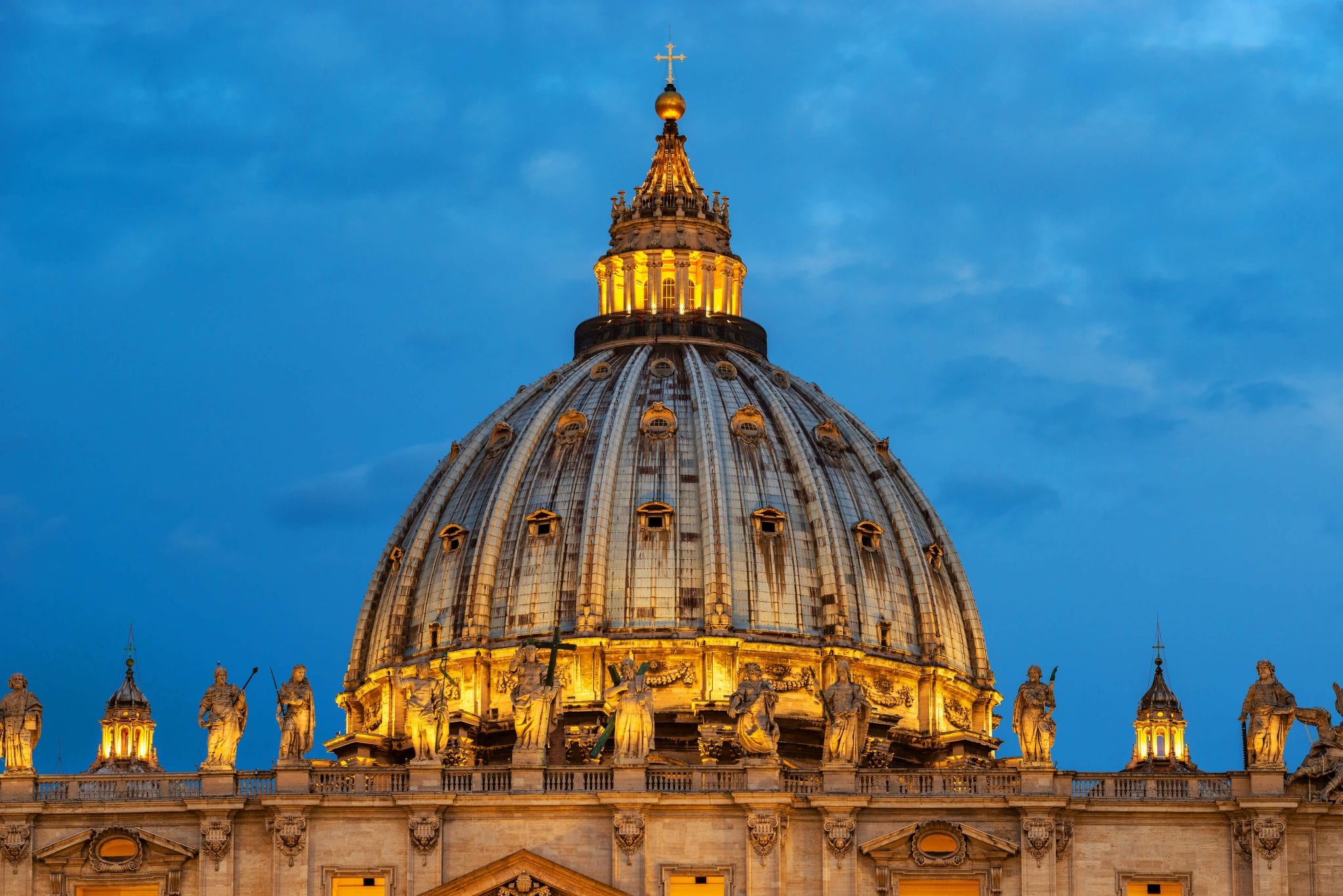
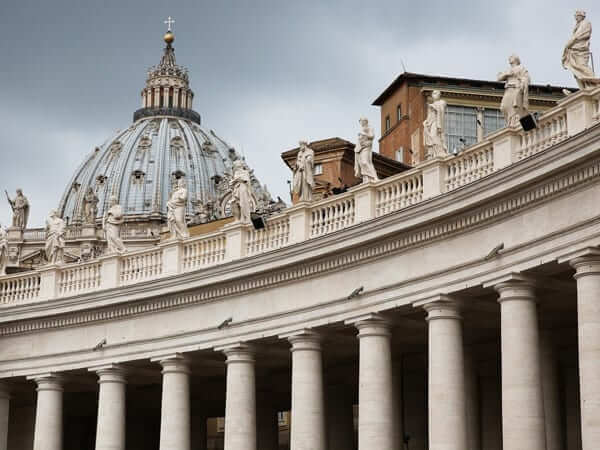
A series of figurine sculptures or statues line the roof in front of the famous dome!
FAQs – Facts About Visiting St. Peter’s Basilica
Do you need tickets to enter St. Peter’s Basilica?
No, entry to St. Peter’s Basilica is free of charge. However, security checks are mandatory, and queues can be long, especially during peak season. If you want to skip the stress, many visitors choose a guided tour or early morning entry.
What are the opening times for St. Peter’s Basilica?
St. Peter’s Basilica is generally open:
- Daily: 7:00 AM – 7:00 PM (April–September)
- Daily: 7:00 AM – 6:30 PM (October–March)
Last entry is typically about 30–60 minutes before closing, and hours may change during religious events or papal ceremonies.
Is there a dress code to visit St. Peter’s Basilica?
Yes. As it is an active place of worship, visitors must dress modestly – shoulders must be covered, no shorts or skirts above the knee and no low-cut tops. Security may refuse entry if the dress code is not followed, so it’s worth planning ahead before you arrive, or taking a wrap or scarf that you can use to cover up if required.
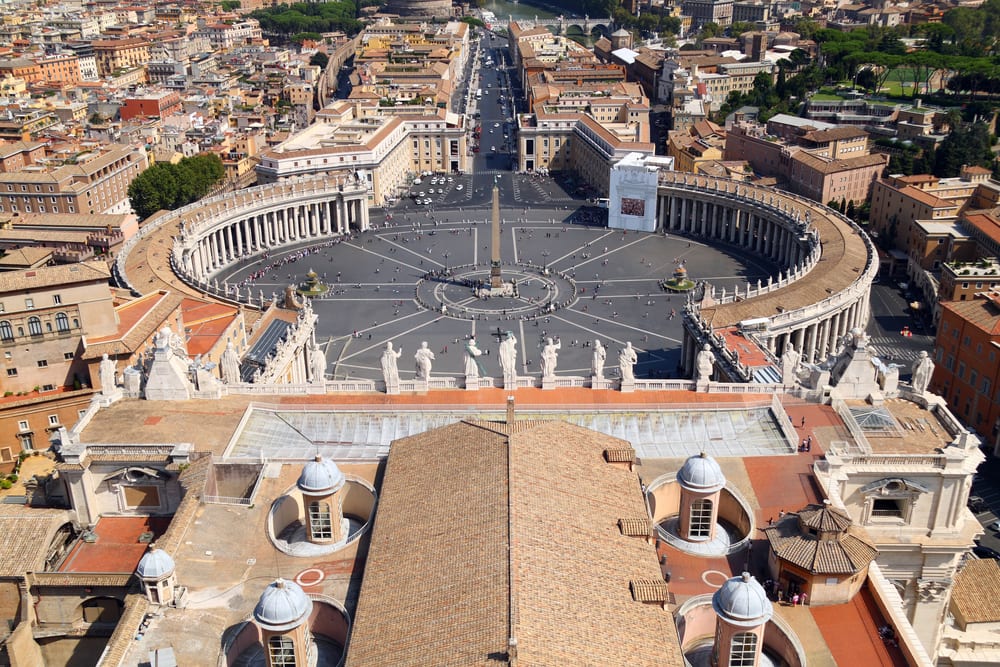
The view from the top of the dome of St. Peter’s Basilica (now you know how big it is!)
Ready to see it for yourself?
Of course, you can admire St. Peter’s Basilica on your own, but to really understand what you’re looking at, from Michelangelo’s dome to the hidden papal tombs below, nothing beats a guided visit.
The best way to understand the scale, history, and secrets of St. Peter’s is with one of our expert-led Vatican City tours, which bring the stories behind the stones to life. Expert local guides bring centuries of history, art, and intrigue to life, and take you places most visitors miss, including up into the dome and down into the crypts.
It’s the difference between simply seeing St. Peter’s, and truly understanding it.


Book a Tour

Pristine Sistine - The Chapel at its Best
€89

1794 reviews

Premium Colosseum Tour with Roman Forum Palatine Hill
€56
850 reviews

Pasta-Making Class: Cook, Dine Drink Wine with a Local Chef
€64
121 reviews

Crypts, Bones Catacombs: Underground Tour of Rome
€69
401 reviews

VIP Doge's Palace Secret Passages Tour
€79
18 reviews

Legendary Venice: St. Mark's Basilica, Terrace Doge's Palace
€69
286 reviews
You May Also Like
Follow us
Stay up to date with travel tips, local insights and all things Italy on our social channels!


Subscribe to our Newsletter
Get curated Italy travel tips delivered to your inbox!

